FDA Elsa AI: Why the Real Challenge for Pharma May Be Workforce Capability, Not the Technology
Author: Nicola Rice, Head of Programmes
Artificial Intelligence is no longer a future discussion in pharmaceutical manufacturing. It is already beginning to influence how organisations approach quality, compliance, regulatory review and operational decision-making.
One recent development attracting significant attention is the FDA’s launch of Elsa, an internal generative AI tool designed to support scientific review, inspections and regulatory workflows. While Elsa does not replace human reviewers or make regulatory decisions independently, it signals something important: regulators are actively exploring how AI can accelerate review processes, identify inconsistencies and analyse large volumes of information more efficiently.
For industry, this raises an important question. If regulators are learning how to work with AI, are manufacturers preparing quickly enough for an increasingly AI-enabled regulatory environment?
AI Has Entered the Regulatory Conversation
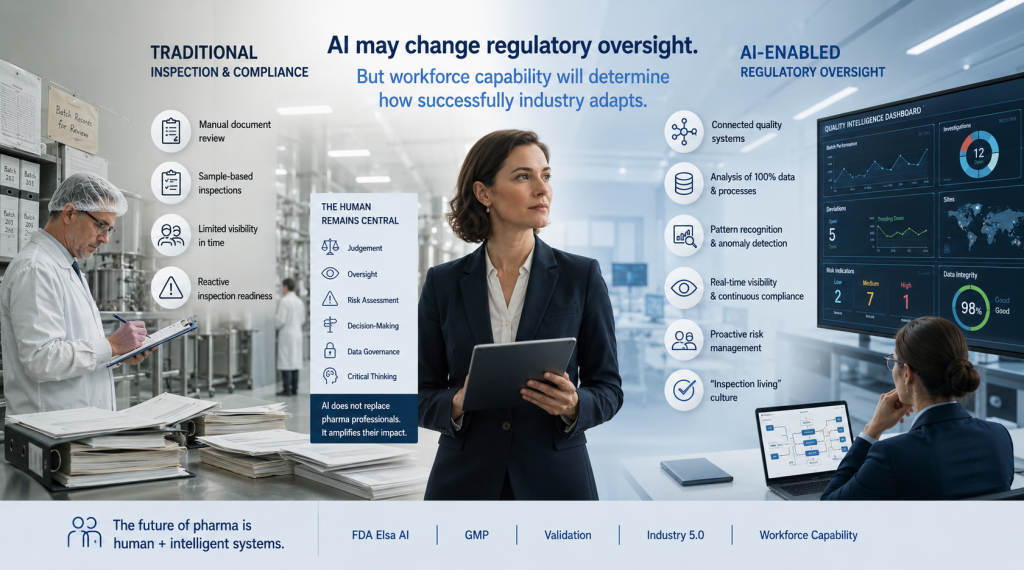
Traditionally, pharmaceutical inspections relied heavily on selective sampling and limited review windows. AI has the potential to fundamentally change that model. Unlike human inspectors working within time constraints, AI tools can analyse entire datasets, identify patterns across systems and surface inconsistencies much more rapidly.
This may increase regulatory focus on long-term behaviours and trends rather than isolated records prepared specifically for inspection. In practice, organisations may need to move away from periodic “inspection readiness” towards what some are beginning to describe as “inspection living”, a state where compliance, documentation quality and operational visibility are continuously maintained rather than temporarily intensified before inspections.
That shift has major implications for pharmaceutical manufacturing, validation and quality teams.
From Technology Discussion to Capability Discussion
Many organisations are already exploring how generative AI may support activities such as document summarisation, deviation trending, CAPA analysis, knowledge retrieval and regulatory intelligence. However, the challenge in regulated environments is not simply using AI. The challenge is using it responsibly, transparently and compliantly within GMP systems.
In pharmaceutical manufacturing, an AI tool cannot simply be efficient or innovative. Organisations will still need to demonstrate data integrity, traceability, human oversight, risk management and defensible decision-making. As AI becomes more embedded within regulated workflows, strong data governance and consistent documentation practices become increasingly important.
Much of the current industry discussion around AI focuses on the technology itself. Far less attention is being paid to the capability shift required within the workforce.
Future validation, quality and technical professionals may need a very different mix of skills than those traditionally associated with pharmaceutical manufacturing. Technical expertise will still matter, but it may no longer be enough on its own. Increasingly, organisations may require professionals who can interpret AI-supported outputs, evaluate risk, identify contextual limitations, challenge questionable conclusions and apply sound engineering and scientific judgement within highly regulated environments.
In many ways, the future role becomes more human, not less.
Industry 5.0 and the Future GMP Workforce
This aligns closely with the broader Industry 5.0 discussion currently emerging across manufacturing sectors. While Industry 4.0 focused heavily on automation and digitalisation, Industry 5.0 places greater emphasis on the interaction between people, intelligent technologies and resilient systems.
As systems become more technologically advanced, human judgement, adaptability and decision-making become increasingly valuable.
For pharmaceutical organisations, the real challenge may not be whether AI arrives within GMP environments. It is how quickly organisations can develop the workforce capability, governance structures and operational maturity required to use AI safely and effectively.
Organisations do not need to fully deploy generative AI tomorrow to begin preparing. However, this is an important time to strengthen AI literacy, improve data governance, review digital maturity and begin discussing how validation, quality and compliance functions may evolve over the coming years.
Final Thoughts
The FDA Elsa discussion matters not simply because of one AI tool, but because it signals a broader transition in how regulated environments may operate in the future.
The pharmaceutical industry has spent years preparing for digital transformation. The next challenge may be preparing people to work confidently, critically and compliantly alongside AI-enabled systems.
Organisations that begin building those capabilities now are likely to be better positioned as regulatory expectations, technologies and workforce requirements continue to evolve.
Get in touch with us at Innopharma to discuss your training needs or access skilled personnel who can make an immediate impact.