AI Literacy is No Longer Optional. Your Next Regulatory Inspection Might Prove It.
Author: Nicola Rice CEng, Head of Programmes, Innopharma Technical Services
For the past two years, I’ve heard the same sentence in almost every client meeting.
“We’re waiting for the regulators to tell us what we can do with AI.”
That excuse has just become much harder to defend.
Over the past few weeks, the European Medicines Agency (EMA) has held a major multi-stakeholder workshop to shape Annex 22, the new guidance on the use of AI in medicines manufacturing. The discussion explicitly includes Generative AI and Large Language Models in GMP manufacturing environments.
Read that again.
The conversation has moved from “Should we use AI?” to “How should we govern AI?”
Those are two very different questions.
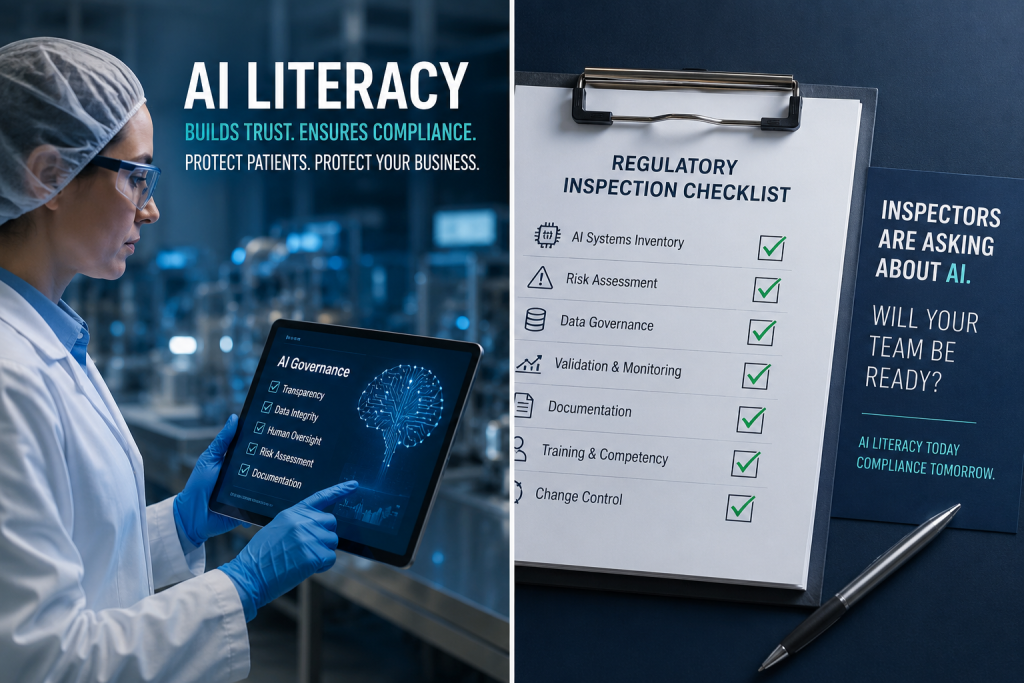
Most Organisations Have the Wrong Problem
Whenever companies tell me they need an AI strategy, I usually disagree.
They don’t have an AI problem.
They have a skills problem.
Buying Microsoft Copilot licences doesn’t make an organisation AI-enabled.
Writing an AI policy doesn’t make people AI-literate.
Running a one-hour lunch-and-learn doesn’t create competent engineers.
The companies that will pull ahead over the next five years won’t necessarily have the best AI tools. They’ll have the workforce that knows when to trust AI, when to challenge it, and when to ignore it completely.
That’s a capability issue, not a technology issue.
Validation Engineers Are About to Become AI Validators
Think about how much regulated work already depends on professional judgement.
Activities such as the following are increasingly being supported by AI-powered tools:
- Reviewing deviations
- Writing validation protocols
- Risk assessments
- Change control
- Root cause analysis
- Technical investigations
AI can now assist with every one of these.
But assistance creates a new responsibility.
If AI helped write your protocol, who validated the output?
If AI summarised your deviation, who verified the scientific interpretation?
If AI drafted your risk assessment, who owns the final decision?
The answer is still the same as it has always been.
A competent human does.
The role isn’t disappearing.
It’s evolving.
The Next Skills Gap Isn’t Technical
Current research increasingly focuses on the future skills required for Industry 5.0 within pharmaceutical and biopharmaceutical manufacturing.
One finding has remained remarkably consistent.
The organisations that perform best are not those with the most advanced technology.
They’re the ones that combine technical capability with human capability.
Professionals will increasingly be expected to demonstrate:
- Critical thinking
- Digital judgement
- Systems thinking
- Communication
- Ethical decision-making
- Risk-based decision making
Ironically, these are the very skills AI cannot replace—but makes far more valuable.
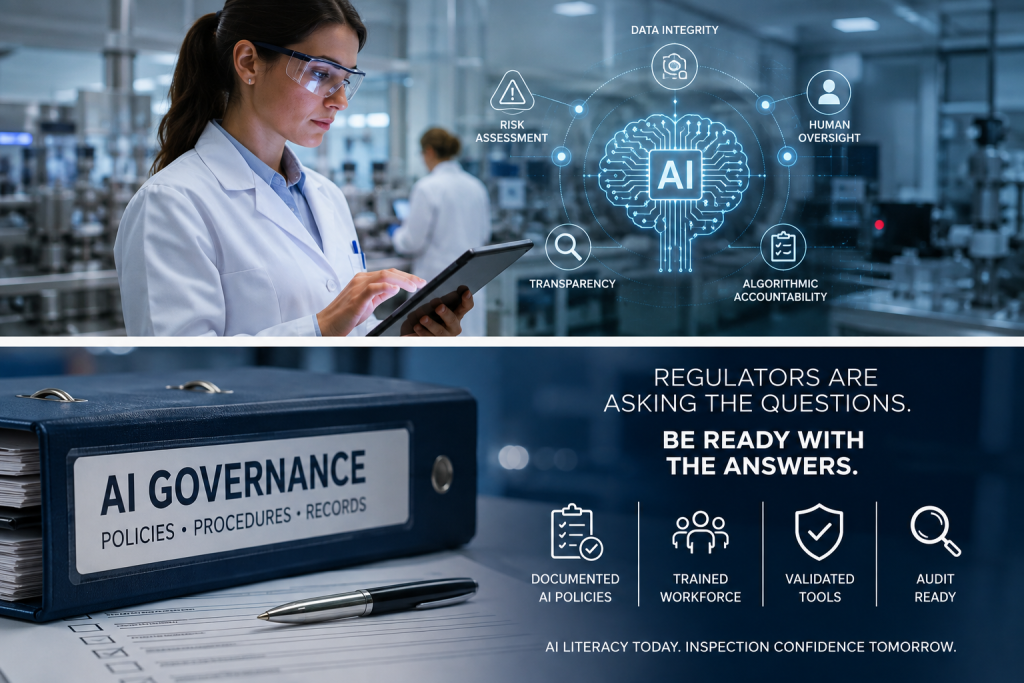
Workforce AI Competence During an Inspection
Here’s the uncomfortable question.
Imagine an inspector asks:
“Show me how your staff are competent to use Generative AI within your quality system.”
Could you answer confidently?
Could you demonstrate:
- Who has been trained?
- What they are allowed to use?
- What they are prohibited from using?
- How outputs are verified?
- How data integrity is maintained?
- How human oversight is assured?
Many organisations have governance documents.
Far fewer have workforce competence.
That distinction will matter.
Building AI Capability Should Start Now
Stop asking whether AI will replace jobs.
It’s the wrong debate.
The better question is:
Which organisations will replace people who don’t know how to work with AI?
History suggests every major technological shift rewards those who learn first.
Pharmaceutical manufacturing won’t be any different.
The future won’t belong to the companies with the most AI.
It will belong to those with the most AI-capable workforce.
And those are two very different things.
At Innopharma Technical Services, we work with life sciences organisations to develop the technical capability required for today’s regulated manufacturing environment. As AI becomes part of everyday GMP operations, developing AI literacy will be just as important as adopting the technology itself. If you would like to discuss AI literacy, workforce capability or bespoke training for your organisation, please get in touch with our team at [email protected].
About the Author
Nicola Rice CEng is Head of Programmes at Innopharma Technical Services and a Chartered Engineer. Her doctoral research at the University of Limerick explores the future skills required for Ireland’s pharmaceutical and biopharmaceutical workforce in the transition towards Industry 5.0, with a particular focus on digital capability, AI readiness and workforce development.