Why Basic Risk Tools Still Matter: A Look at the New ICH Q9(R1) Training Materials
Author: Nicola Rice, Head of Programmes
The release of the updated ICH Q9(R1) training materials is a welcome development for anyone working in quality risk management (QRM). While much of the focus in QRM tends to be on formal tools and methodologies, one section in particular stands out for its practical value: Briefing Pack 2 on Basic Risk Management Facilitation Methods.
At first glance, there’s nothing groundbreaking here. The tools covered, process maps, flowcharts, checklists, fishbone (cause-and-effect) diagrams, mind mapping, and Pareto charts, are all familiar. Most professionals have come across them at some point, and many use them regularly.
So, what’s the big deal?
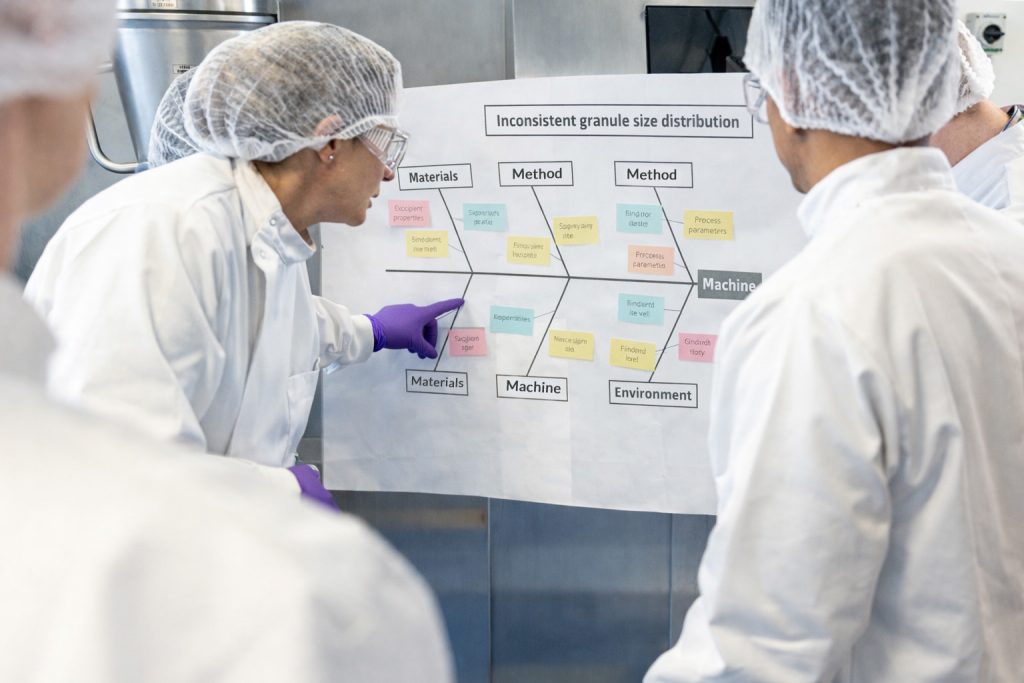
Putting “Basic” Tools in Their Proper Place
What the updated materials do particularly well is reposition these tools. Instead of treating them as informal or optional add-ons, they are now clearly embedded within the Q9(R1) risk management process itself.
This is an important shift.
Too often, teams jump straight into formal risk assessments, FMEA, HACCP, or similar, without first clearly defining the problem. The result? Poorly framed risks, unclear scope, and ultimately weaker decisions.
The so-called “basic” tools are what help prevent this. They provide structure at the very start of the process:
- Process maps and flowcharts help you understand what’s actually happening
- Checklists ensure nothing obvious is missed
- Fishbone diagrams and mind maps support structured thinking around causes
- Pareto charts help prioritise what really matters
Used properly, these tools don’t just support risk management, they set it up for success.
Better Framing = Better Decisions
One of the biggest takeaways from this briefing pack is the emphasis on problem framing. Before you analyse risk, you need to be clear on what the problem actually is.
This sounds obvious, but in practice it’s where many teams struggle.
Good facilitation, using simple, well-chosen tools, helps teams align, clarify scope, and agree on what they are trying to solve. That clarity carries through the entire risk management process.
Practical Value for Day-to-Day Work
What makes this update particularly useful is how practical it is. This isn’t theory-heavy guidance, it’s directly applicable to everyday work in quality, manufacturing, and compliance environments.
If you’re involved in deviations, investigations, change controls, or formal risk assessments, these tools will already be part of your workflow, whether you realise it or not. The difference is in how deliberately and effectively you use them.
This Is What Real-World QRM Looks Like
At Innopharma Technical Services, this isn’t theoretical.
We’ve used these tools “in anger” in real manufacturing and quality environments. We teach them every day. Our engineers apply them every day on the ground.
That practical experience is what makes the difference, knowing not just what the tools are, but when and how to use them effectively.
Final Thought
The key message is simple: good facilitation is the foundation of good risk management.
The updated ICH Q9(R1) materials reinforce something that’s easy to overlook, basic tools aren’t basic because they’re unimportant. They’re fundamental.
And when used well, they can make the difference between a superficial assessment and a truly effective one.
If you’re looking to strengthen your team’s risk management capability, this is exactly where to start.
Whether it’s training your team, building internal capability, or bringing in experienced professionals who can apply these tools from day one, we can help.
Get in touch with us at Innopharma to discuss your training needs or access skilled personnel who can make an immediate impact.
Full training pack available here.